









6.64→5.06
Less pain on average
Pain score out of 10. A lower score means less pain.
A non-surgical injection that can help ease the pain and stiffness of knee osteoarthritis. Explore whether Arthrosamid could help you move more comfortably.
Treatment with Professor Paul YF Lee · 66 Harley Street, London
Olympic swimmer · Arthrosamid patient
Hear her experience of treatment with Professor Paul Lee.
Explore Sharron’s story One person’s experience. Treatment response and recovery vary.If arthritis makes walking, stairs or everyday activities uncomfortable, Arthrosamid may be an option to discuss—particularly when exercise, physiotherapy or pain relief have not given you enough improvement.
IS THIS YOUR STARTING POINT?
These are reasons to start a conversation with the team. The assessment helps establish what is causing your symptoms and which options fit your knee.
Pain or stiffness affects walking, stairs or your daily routine.
You want to understand whether an injection has a place in your treatment plan.
You have tried care such as exercise, physiotherapy or pain relief and want to discuss what comes next.
A starting point for discussion, not a diagnosis or confirmation of suitability.
Your symptoms, examination, scans and medical history guide the recommendation. Advanced arthritis, knee instability or an active infection may change which treatment is appropriate.
Inside your knee
Arthrosamid is a soft, non-absorbable hydrogel injected into the knee joint. It becomes incorporated into the synovium: the soft tissue lining the inside of the joint capsule, highlighted in magenta in the diagram.
The treatment is used to help manage the pain and stiffness of knee osteoarthritis. It acts within the lining, rather than forming a cushion between the bones. It does not rebuild cartilage or cure arthritis.
Arthrosamid is a soft, non-absorbable polyacrylamide hydrogel injected into the knee. It integrates into the synovium, the lining of the joint capsule, rather than acting as a cushion between the bones. It is used to manage osteoarthritis symptoms; it does not rebuild cartilage or cure arthritis.
Review your symptoms and examine your knee. Submit existing scans through the patient portal beforehand.
Ultrasound-guided injection with local anaesthetic and IV antibiotics for every Arthrosamid treatment.
Written aftercare and team contact details provided.
Review of your progress at around six weeks.
Your individual aftercare instructions guide your return to work, driving and exercise.

Plan relative rest.
Avoid strenuous activity.
Build activity gradually.
Review your progress.
Research behind your treatment
The 2025 study followed 269 patients with knee osteoarthritis for two years. On average, patients reported less pain and better knee function at 24 months than before treatment.
Explore the research and results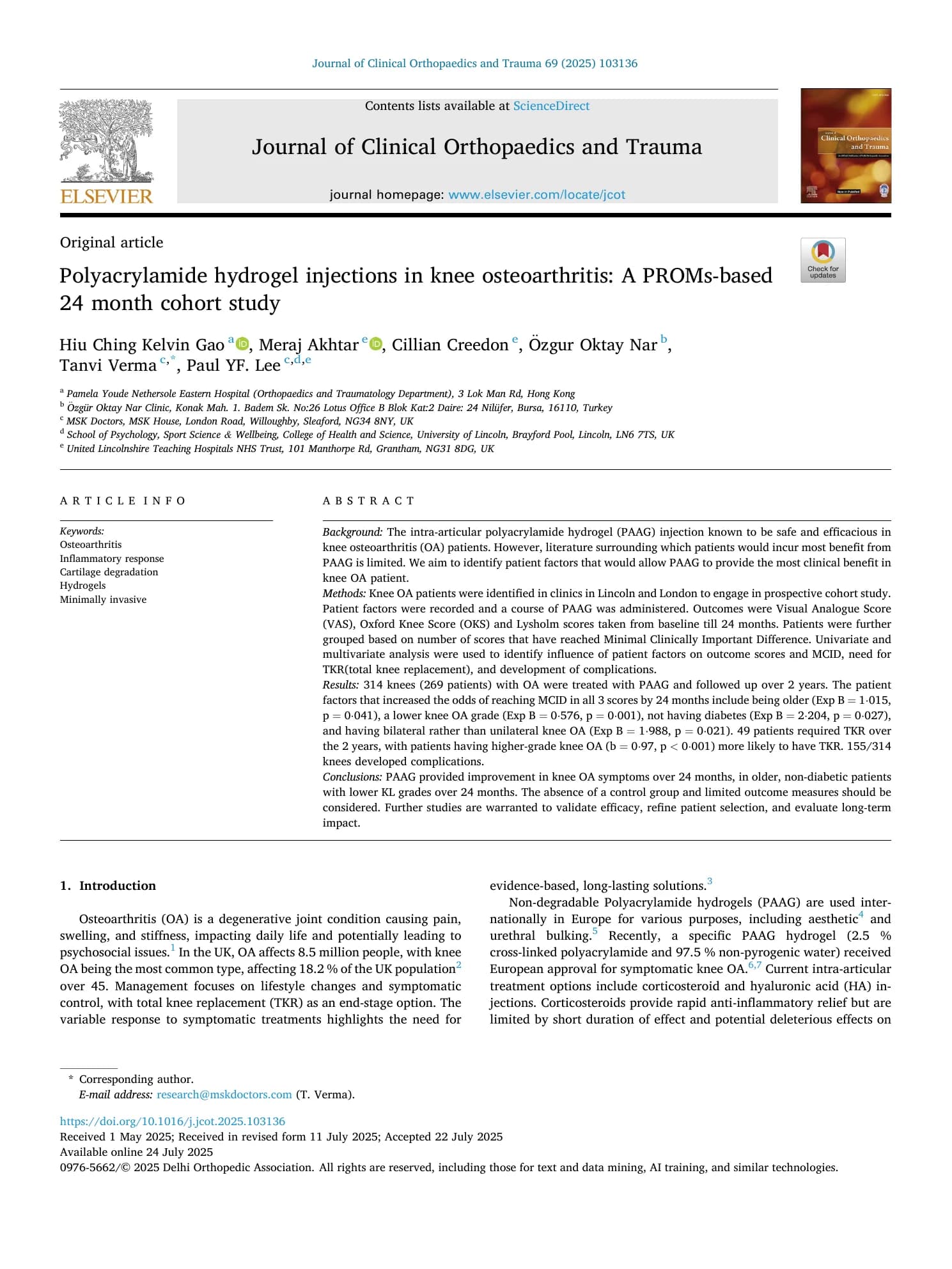
Published group averages · before treatment → 24 months
Pain score out of 10. A lower score means less pain.
Oxford Knee Score. A higher score means better pain and function.
Lysholm score. A higher score means fewer symptoms and better function.
These improvements support discussing Arthrosamid as a symptom-management option. They do not mean everyone improved or became pain-free. Some patients still needed knee replacement.
This observational study had no comparison group, so it cannot establish how much improvement was caused by the injection. Your response and the duration of any relief may differ. See the full findings, safety results and study context →
From research to your assessment
The questionnaire brings together published research and the clinic’s treatment experience to help organise a personal discussion. It looks beyond the treatment name to your symptoms, joint history, health and goals.
The published cohort followed 269 patients over 24 months. It examined how patient factors related to changes in pain and knee function.
The current assessment considers joint symptoms and wear, age, diabetes, previous surgery, walking ability and expectations. Its discussion scores help identify topics to explore.
Your clinician checks the diagnosis, examination and imaging, then discusses the options alongside what you want treatment to help you do.
The questionnaire is a discussion aid, not a validated prediction of treatment success. Study findings describe groups; only a clinical assessment can confirm suitability.
Explore your options
The right choice depends on your knee, the relief you need and your recovery priorities.
Compare treatment approaches
Compare their different roles
Explore another injection option
Understand when surgery may be discussed
Explore all alternatives, including exercise and physiotherapy
Professor Lee explains how assessment, sterile preparation, ultrasound guidance and aftercare contribute to your treatment.
Temporary soreness, swelling or stiffness can follow treatment. Joint infection is a serious possible complication. We use sterile technique, ultrasound guidance and IV antibiotics, and explain when to contact the team afterwards.
The amount required is confirmed after assessment. Includes ultrasound, Arthrosamid product, procedure, IV antibiotics and six-week follow-up.

Consultant-led assessment and treatment, with a plan built around your knee and the activities that matter to you.
1,200+Arthrosamid injections performed at the clinic
As of August 2026
Start with the questions patients often ask. Our full guide goes further into treatment, results and everyday practicalities.
Explore all Arthrosamid FAQsStart with a free introductory call with our team, or book a clinical assessment with Professor Lee.