







Learn from patient outcomes
The published cohort followed 269 patients over 24 months. It examined how patient factors related to changes in pain and knee function.
Understanding the evidence for polyacrylamide hydrogel injections in knee osteoarthritis, and what published outcomes mean for your decision.
Journal of Clinical Orthopaedics and Trauma, 2025. Co-authored by Professor Paul YF Lee.
Read primary study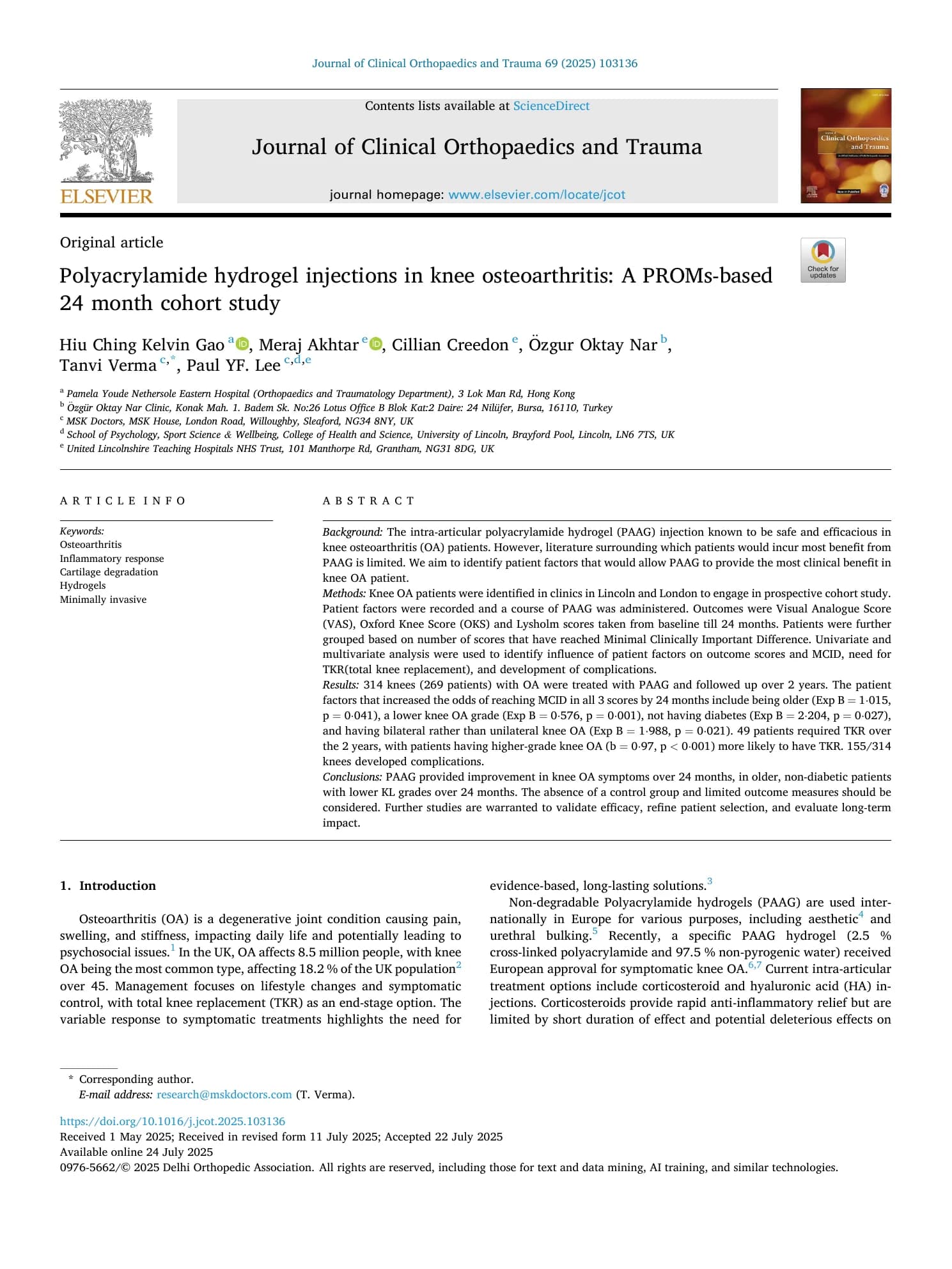
From research to your assessment
The questionnaire brings together published research and the clinic’s treatment experience to help organise a personal discussion. It looks beyond the treatment name to your symptoms, joint history, health and goals.
The published cohort followed 269 patients over 24 months. It examined how patient factors related to changes in pain and knee function.
The current assessment considers joint symptoms and wear, age, diabetes, previous surgery, walking ability and expectations. Its discussion scores help identify topics to explore.
Your clinician checks the diagnosis, examination and imaging, then discusses the options alongside what you want treatment to help you do.
The questionnaire is a discussion aid, not a validated prediction of treatment success. Study findings describe groups; only a clinical assessment can confirm suitability.
The background to the questionnaire
The original clinic questionnaire was described as drawing on an independent clinical study and a wider real-world series of more than 600 patients. That wider experience is separate from the published 269-patient cohort.
The published study examined factors including age, osteoarthritis grade and diabetes. The current questionnaire also asks about previous surgery, walking ability, the pattern of symptoms and expectations to support the consultation.
The online discussion scores are not the paper’s statistical model, and should not be read as a percentage chance of success. A clinician must interpret your answers alongside examination and imaging.
The published cohort reported improvements in pain and knee function over the two-year follow-up period. The study tracked progress using three standard clinical measures.
A standardised scale used clinically to measure the severity of knee pain experienced by patients during their daily activities.
A focused questionnaire assessing how well patients can manage practical physical tasks like walking, navigating stairs and shopping.
Detailed evaluation of specific mechanical symptoms including limping, catching, swelling, and stability of the joint during movement.
The peer-reviewed cohort recorded improvements in pain, Oxford Knee Score and Lysholm knee-function measures through 24 months in routine specialist care.
The results provide practical evidence for treatment discussions and show why stage of osteoarthritis and health factors such as diabetes matter when selecting patients.
Total participants enrolled
Treated with specialist care
Follow-up up to 24 months
London and Lincolnshire centers
Prospective clinical study design
Single-injection Arthrosamid® treatment
Bilateral Treatment: Some patients received injections in both knees where clinically appropriate.
The numbers below come from the peer-reviewed London Cartilage Clinic/MSK Doctors paper. They are published study findings, not clinic activity totals. The design, safety observations and knee-replacement outcomes should be read alongside the improvements reported for the group.
Arthrosamid 24-month observational cohort design and outcomes
| Item | Published report | How to interpret it |
|---|---|---|
| Design and population | Prospective observational cohort; 269 patients, 314 knees | Real-world cohort, not a randomised trial |
| Follow-up | Up to 24 months | An observed study period, not a duration guarantee |
| Pain (VAS) | Mean 6.64 at baseline; 5.06 at 24 months | Group mean; individual responses varied |
| Oxford Knee Score | Mean 25.35 at baseline; 31.95 at 24 months | Observational design without a control group |
| Lysholm score | Mean 45.22 at baseline; 56.15 at 24 months | No untreated or active comparator group |
| Complications and tolerance | Across 314 treated knees: pain 51 (16.2%), effusion 52 (16.6%), swelling 47 (15.0%), overlying skin infection 3 (1.0%), deep infection requiring washout 2 (0.6%). | Reported during follow-up in this cohort; these are not an individual risk prediction or a separate clinic safety audit. |
| Knee replacement | 49 of 244 treated knees in the study’s age-50-and-over replacement analysis required replacement within two years. | More advanced arthritis was associated with progression. This does not establish that the injection prevents or delays surgery. |
Read the full peer-reviewed cohort or use the DOI record. The publication describes the prospective cohort design, patient population, outcome measures, subgroup findings, complications and progression to knee replacement.
Professor Lee also co-authored a 2022 systematic review of five early reports covering 463 combined patient outcomes and a separate single-patient patellofemoral case report. Those designs are supporting context, not equivalent to the larger prospective cohort; individual results vary.
A patient review describes one person's experience and can help assess service, communication and aftercare. It cannot establish treatment efficacy, incidence of complications or the result another patient should expect.
Patients completed established measures of pain (VAS), everyday function (Oxford Knee Score) and knee performance (Lysholm score) before treatment, at six weeks, six months, one year and two years.
The researchers also recorded age, medical conditions including diabetes, arthritis severity, whether one or both knees were treated, complications and progression to knee replacement. Clinically important change thresholds helped distinguish meaningful improvement from small score changes.
Average scores improved, but responses varied. Exploratory analysis associated older age, a lower arthritis grade, absence of diabetes and bilateral knee involvement with a greater chance of reaching meaningful improvement across all three measures. These associations are not a validated prediction tool.
Patients with more advanced arthritis were more likely to progress to knee replacement. An injection acting on the joint lining cannot replace lost joint surfaces. For substantial pain, deformity or loss of function, a surgical opinion may be the more useful next step.

These findings help inform a conversation about your knee: what you would like to do more easily, what your scans show and which options fit your goals.
Prospective observational cohort: This study followed a specific group of treated patients over time in a real-world clinical setting. It is not a randomised controlled trial comparing Arthrosamid against a placebo.
Follow-up duration: The 24-month period refers to the length of time these patients were actively tracked by researchers. It is a measurement milestone, not a guaranteed duration of benefit for future patients.
We use the evidence alongside your diagnosis, scans, previous care and goals. Arthrosamid is not a routine recommendation for every painful knee: we discuss expected benefit, risks and alternatives, and decline treatment when it is unsuitable.
The two-year follow-up is a study milestone, not a promise of two years of relief. Arthrosamid does not cure arthritis, regenerate cartilage or establish that surgery can be delayed. A questionnaire can organise your concerns, but suitability is a clinical decision.
Start your suitability assessment or read how we assess your knee.
Additional published reviews and case reports.
A structured review combining clinical data from five early reports detailing 463 patient outcomes following treatment.
A documented single-patient case report detailing the specific clinical presentation and outcome for an individual with this lesion type.

Professor Paul YF Lee, Consultant Orthopaedic Surgeon
Research provides the foundation, but it is just one part of your decision. In clinic, we discuss these published findings alongside a physical examination, your specific imaging, and the activities you want to get back to. This determines if Arthrosamid is a practical option for your knee.
Olympic swimmer · Arthrosamid patient
Sharron Davies MBE shares her experience of Arthrosamid treatment with Professor Paul Lee. Watch her film and explore the story behind her decision.
One person’s experience. Your treatment options, response and recovery may differ.
Published evidence shows group-level improvements in pain and knee function through 24 months. A prospective observational cohort of 269 patients and 314 knees reported group-level improvements through 24 months. Results vary between individuals, so diagnosis, imaging and suitability assessment remain important.
The published cohort followed group outcomes for 24 months. That is the study period, not a guaranteed duration of benefit. Improvement may develop over the following weeks, with the clinic's early review at around six weeks. Individual onset, size and duration of response vary.
The cohort found better outcomes were associated with factors including lower-grade knee osteoarthritis and the absence of diabetes. These group associations inform patient selection but do not predict an individual response. Diagnosis, imaging, contraindications, function and alternatives still require clinical assessment. See the Arthrosamid® suitability self-assessment for a structured indication of fit.
If improvement is absent or below expectations, the clinic reviews the diagnosis, imaging, function and other pain sources rather than assuming another injection is the answer. Rehabilitation, another non-surgical option or a surgical opinion may be more appropriate.
Yes. The London Cartilage Clinic/MSK Doctors 24-month prospective cohort is peer reviewed and linked on this page by full text and DOI.
Arthrosamid® is not a substitute for knee replacement where replacement is clinically appropriate. Arthrosamid has not been proved to delay or prevent knee replacement. It may be considered for symptom management in an appropriately selected adult, while advanced disease, deformity or major functional loss may make replacement assessment more suitable.